We'd like to extend an invitation to all our followers in the Boise area to come visit us at the 2015 Boise Flower and Garden show this weekend. As many of you know, we were given the honor to build one of the two lobby gardens for the show this year.
We've spent most of our winter "down time" conceptualizing and constructing a garden pavilion that we hope will inspire and challenge visitors.
Check out the link below for a taste of what you'll see.
We hope to see you this weekend!
Tuesday, March 17, 2015


Wednesday, March 11, 2015
Winter Injury
I've heard folks describe our winter as one of the mildest they've ever seen in our area. So why do so many conifers that looked so peachy back in the fall now look this?

Or like this?

A recent post by a respected local garden blogger described it as the result of bitter cold we experienced earlier this winter. Cold? Yep. It got cold (1 F°), but only briefly and well within historical averages and certainly within the tolerance of the many conifers that were damaged this winter.
So what gives?
The short answer is it's not the cold per se, but rather the whiplash nature of the weather in November. We enjoyed a late gardening season with warm weather into November, and then we were nailed by a polar vortex that dropped temperatures from a high/low of 69 F°/46 F° on November 9th, to a high/low of 22 F°/1.2 F° less than a week later!
Some plants just have a really tough time riding these kinds of rapid transitions. One of the conifers that has struggled the most in Boise is the Hinoki cypress. I bet you can pick it out in this line up.

Here's another Hinoki cypress in my own yard.

And another Hinoki cypress in my parent's landscape. Note how green the bamboo looks (what winter?).

Another interesting aspect of this "whiplash weather" is how it impacted the same kind of tree so differently. A friend and I were puzzling this morning on why the White pine on the left fared so poorly compared to his buddy on the right. Southwest exposure? Wind protection/exposure? A difference in the water holding capacity of the beds on either side of the driveway? Go on, speak up if you think you know.

Unsurprisingly, I've had numerous calls and consultation requests during the last month. My advice? First, given our warm weather, seriously consider turning on your sprinklers early this year. Desiccation is really rough on a weakened tree. Second: be patient and wait to see if the tree pushes new growth. It may be June until you can really see the extent of the permanent damage. My prediction is that most of the pines will spring back. I'm not so sure about some of the Hinoki cypress (including my own).
Friday, February 27, 2015
An Artist's Garden
 Local Boise artist, and all around classy lady,
Ardith Tate, approached me last fall for ideas on how to convert a small common
area into a sitting garden. Primarily turf, with a small foundation planting
against her house and dominated by an adjoining parking area of concrete and asphalt,
Ardith nevertheless enjoyed setting up her bright lime green garden chairs in the grass to
commune with the outdoors and neighbors alike.
Local Boise artist, and all around classy lady,
Ardith Tate, approached me last fall for ideas on how to convert a small common
area into a sitting garden. Primarily turf, with a small foundation planting
against her house and dominated by an adjoining parking area of concrete and asphalt,
Ardith nevertheless enjoyed setting up her bright lime green garden chairs in the grass to
commune with the outdoors and neighbors alike.
A stroll through her house to see her artwork and
design sensibilities revealed that this was someone who’d be open to the
unconventional. I didn't think a deck was a good option, I explained, because you’d feel perched
above the parking lot and lose a certain degree of connection to the
surrounding landscape (detached, raised pagodas and decks are often better for
giving political speeches or hosting weddings).
Tossing the deck idea on its head, I suggested
that we sink a patio area into the ground, taking a literal approach to being “in
the garden.” And since ruin gardens are
cool again, I proposed a crumbling
section of the surrounding retaining wall, à la Angkor Wat.
Concept Sketches


Measurement, excavation and construction (um, you called the utility locators, right?)


Retaining wall and patio construction (who needs laser measurement when you've got spare poly pipe?)


With the completion of the stone patio/walkway, and a little colony of Elfin thyme planted with a blessing to go forth and multiply over the garden ruin, we turned our attention to the planting scheme. Ardith had hoped that the new garden area would be a bit more waterwise; an easy task given that virtually anything (aside from domesticated rice?) would be an improvement over the turf grass we removed.
Dry woodland garden perennials aren't the obvious choice for a waterwise garden, but given their low water requirements relative to turf and the decreased footprint of the irrigation thanks to the hardscape,we were able to significantly reduce the irrigation needs of this small area.
 |
| I dunno, Ardith, I'm kind of thinking the old lime green chairs would have been just fine... |
Thursday, January 1, 2015
A Year Later
As we accelerate through the final few days of 2014, it seems fitting to revisit a project that I introduced exactly a year ago today in a blog titled Draw!. We'd completed enough of the project at that point to compare with a patio concept sketch I'd completed earlier in the year.


January of 2014 didn't provide us with ideal landscaping weather, but we persevered, completing the patio fire feature in February
.


By late summer the hardscape had been in for months and the plants had really begun to fill in.

And so we come full circle. Happy New Year everyone!

January of 2014 didn't provide us with ideal landscaping weather, but we persevered, completing the patio fire feature in February
.
By late summer the hardscape had been in for months and the plants had really begun to fill in.
 |
| Plant tapestry, anyone? |
And so we come full circle. Happy New Year everyone!
Sunday, September 28, 2014
Larry Miller Subaru Turf to Xeriscape Conversion
 The folks over at the Boise Larry Miller Subaru had a problem: the two south facing areas of turf in front of their showroom looked nice enough, but demanded an obscene amount of water. Worse, over-spray from the broadcast irrigation was staining their shiny new Subarus.
As a sponsor/supporter of the Idaho Botanical Garden, naturally Larry Miller Subaru turned to IBG for turf alternative ideas. IBG horticulture director Toby Mancini, sketched up a plan that included creating berms in the two areas out of a specific soil "recipe" (25% organic compost, 25% fractured 1/4" gravel and 50% screened topsoil), especially formulated for xeric, zonally adapted plants. The plants he specified read like a list of the "who's who" list of dependable, drought tolerant and readily available specimens, perfect for the dry intermountain west. They included:
 |
| Philadelphus lewisii 'Blizzard' |
 |
| Fallugia paradoxa |
 |
| Agastache rupestris |
 |
| Panicum virgatum "Heavy Metal' |
 |
| Nepeta racemosa 'walker's low' |
 |
| Oennothera macrocarpa subsp. incan 'Silver Blade'® |
 |
| Echinacea x 'Cheyenne Spirit' |
 |
| Thymus pseudolanuginosus |
We jumped at the opportunity when Toby asked us if we be interested in the installation and were able to complete the project in a single day (including the conversion of the broadcast sprinkler system over to single source drip system for each plant*).
 |
| Clean up after a long day. |
 |
| Fresh installation = lots of negative space. By mid-summer next year, the plants will really start filling in. |
*I generally prefer broadcast irrigation because I believe it promotes good lateral root development as well as a vibrant soil ecology. This is a great example, however, where drip was the right way to go to eliminate wasteful over-spray as well as runoff from the berm. Our preferred approach is to loop a 1/4" line with 6" emitter intervals all around each plant, making sure that each 1/4" line is directly connected to a 1/2" feed line for even water volume throughout the bed and even distribution of water around each plant.
Thursday, September 11, 2014
Industrial Park


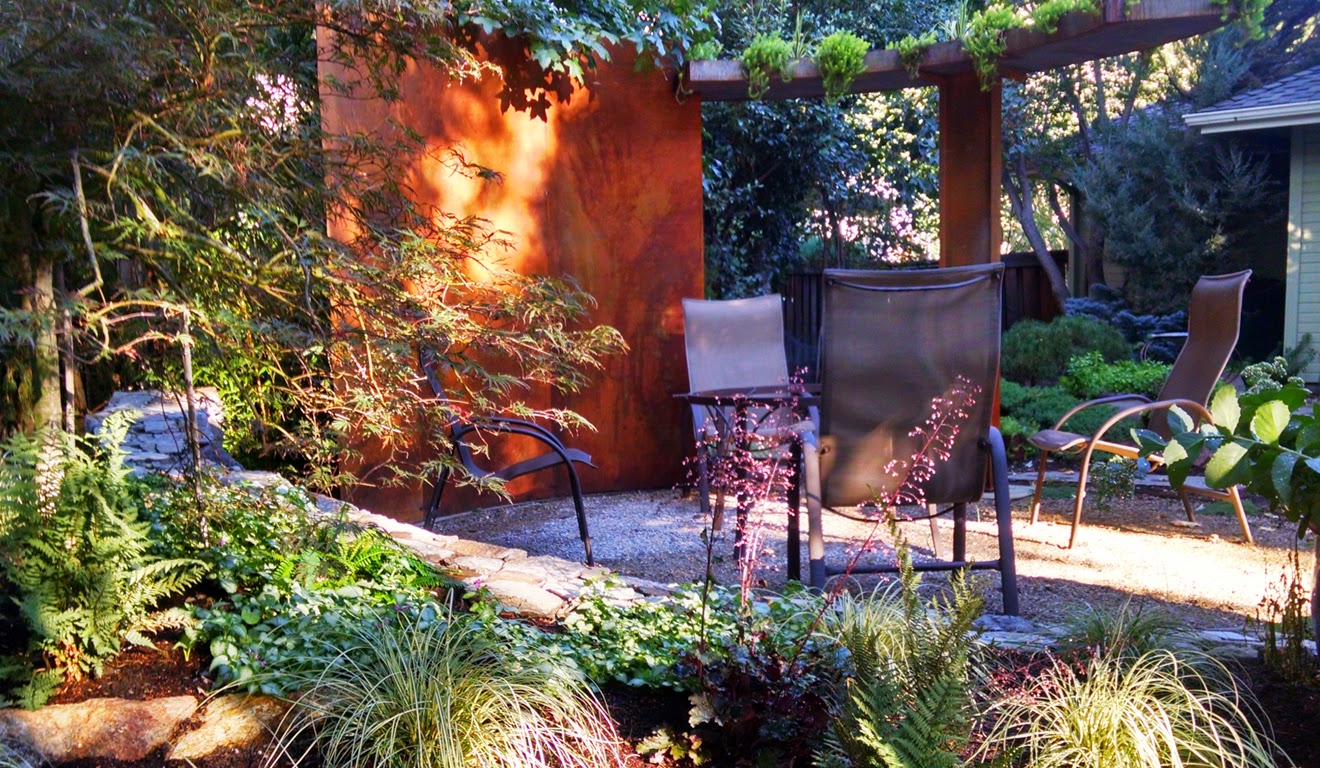
A concave 8' x 9' oxidized steel panel acts as the back wall and abstract focal point "painting" for the room. An arcing, andesite stone wall, green roof arbor and steel edging all add to the feeling of an open, yet delineated space within the garden.

 |
| A Yankee doodles. |
The vertical expression of these concentric circles (the panel, the arbor and sloping andesite wall) are all critical in defining the space.
 |
| A completed concept. No, wait- the rocks are too much. |
The home is in a neighborhood nestled against the Boise river that provides a micro-climate achingly close to zone 7, with trace amounts of honest-to-gosh humidity and an actual water table; perfect for the dry, woodland, under-story plants we installed.


 |
| Just another Mendelssohn/Front 242 mashup. |
The process...
 |
| Before the intervention. |
 |
| Construction of the andesite wall and steel panel base. |
 |
| Kevin Knickrehm attaching the green roof arbor to its i-beam armature. |
 |
| I almost like it as well unplanted. Almost. |
 |
| As I was flying by. |
Thursday, June 19, 2014
So We Left the Tree Zoo for a Night…
I’ll let you in on a secret: I've been complicit in my own kidnapping
every father’s day for the last seven years. Regardless of how busy the
landscaping season is, we ditch the City of Trees (AKA the tree zoo) and head to the mountains to see the real thing- the “real
thing’ in this instance being an actual forest that doesn’t require my help to
sustain it.*
I ran feral in an eastern hardwood forest as a young child,
so I’m always a little surprised to find myself surprised to see a self-sustaining
forest. Boise is a great place to live,
but by the middle of June the foothills have already lost their brief, verdant
veil and begin to don an increasingly washed out, brown aspect.

What a difference 60 miles and several thousand feet of
elevation can make.

The old Forest Service guard house we lovingly refer to as
our “time share”, sits next to Beaver
Creek about 30 miles north of Idaho City. Hiking east along Beaver Creek will
connect you to the Crooked River trail system and more wild trees than you can shake a stick at. And not just trees but
shrubs, grasses and forbes with nary a drip emitter to be seen!
 |
| The very underutilized Buckwheat (Eriogonum). |
 |
| Perennial geranium |
 |
| Wild heuchera happily anchored in a granite outcrop. |
 |
| Color. Texture. Form. |
 |
| When I combined sedum & heuchera in this project, a friend remarked how odd they thought this combination was. Ha! |
 |
| First time I've seen this wild clematis. I definitely need to find out more about this plant! |
 |
| Yep, that's a landscaper's hand. |
 |
| Back to Boise. |
* Full disclosure/laborious backstory: When I was MUCH younger, I rappelled out of helicopters to suppress fires in an effort to “sustain” the forest. This wasn’t too long after Yellowstone had erupted into an enormous bonfire. Debate still rages on in regards to proper “forest management”, but for the sake of the story can we just forget about life in the so called Anthropocene? Please?
Subscribe to:
Posts (Atom)